Multiplication fact fluency is one of the most critical milestones in elementary mathematics. When students transition from slow, effortful counting strategies to rapid, automatic recall, they free up valuable mental space for higher-level problem solving, fractions, and multi-step algorithms.
However, building fluency isn't just about handing students a random sheet of math problems and setting a timer. How worksheets are structured, how many problems are assigned, and even the visual orientation of the equations play a huge role in student success.
Why Math Fact Fluency Matters
Math fact fluency is the ability to recall basic single-digit facts quickly, accurately, and effortlessly. According to Cognitive Load Theory, human working memory has a limited capacity. When a child has to stop and use finger-counting, skip-counting, or repeated addition to figure out 7 x 8, their working memory becomes overloaded.
By automating basic facts through deliberate practice, students create "lexical math memory," allowing them to tackle long division, algebraic expressions, and complex word problems without cognitive fatigue.
The Role of Targeted Worksheet Practice
While conceptual hands-on activities (like arrays and equal groups) are essential for introducing multiplication, structured paper-and-pencil worksheet drills remain one of the most effective tools for consolidating retrieval speed.
Strategic worksheet practice:
- Promotes Direct Recall: Forces the brain to pull answers directly from long-term memory rather than relying on visual aids.
- Provides Low-Stakes Practice: Short, daily drills (1 to 2 minutes) establish a consistent routine without inducing math anxiety.
- Tracks Growth with Clear Visuals: Students can easily see their speed and accuracy improve over time.
Grade-Level Benchmarks: How Many Problems and How Fast?
One of the most common mistakes in fact fluency practice is expecting younger students to complete too many problems in too little time. Appropriate targets must account for both mathematical recall and fine motor handwriting speed.
2nd Grade (Foundational Preparation)
- Target: 15–20 problems in 2 minutes (or 10 problems in 1 minute).
- The Reality: Multiplication fluency is primarily a 3rd-grade standard, but 2nd graders often practice foundational factors like 2's, 5s', and 10's. Because 7 and 8-year-olds are still developing fine motor handwriting speed, a strict 60-second limit can cause panic. Give them 2 minutes to account for writing time.
3rd Grade (Core Mastery)
- Target: 20–25 problems in 1 minute.
- The Reality: 3rd grade is where single-digit multiplication fluency is formally mastered. By mid-to-late 3rd grade, 25 problems per minute represents a solid, research-backed automaticity benchmark (roughly 2.4 seconds per equation).
4th & 5th Grade (Maintenance & Application)
- Target: 25–30+ problems in 1 minute (extending up to 12's facts).
- The Reality: Upper elementary students need automatic recall so that multi-digit algorithms, long division, and fraction operations don't break down. At this stage, physical writing speed is rarely the main obstacle to finishing on time.
Vertical vs. Horizontal Equations: Understanding Layout Mechanics
1. Vertical Formatting (The Gold Standard for Speed Drills)
When students are working on pure speed and automaticity, vertical equations are ideal.
Not all equation layouts serve the same learning goal. Cognitive science shows that visual orientation changes how the brain processes the math.
- Low Visual Friction: Stacking factors reduces eye sweep across operators and equals signs.
- Direct Algorithm Alignment: The vertical format directly mirrors the standard algorithm for multi-digit multiplication that students will use in upper grades.
- Isolates Recall: Removes extraneous cognitive load so the focus stays entirely on memory retrieval.
2. Horizontal Formatting (Syntax & Transfer Challenge)
Horizontal equations (3 X 4 =___) are critical for teaching math syntax and algebraic equivalence (reading left-to-right). However, during speed drills, horizontal layouts can introduce minor visual friction.
- Best Use: Use horizontal sets once a student has mastered vertical recall to test whether they can transfer their fluency to horizontal math sentences without being thrown off by layout changes.
Ready to Build Fact Fluency in Your Classroom?
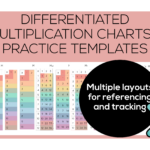
To help your students master their facts without frustration, we’ve designed systematically organized multiplication practice sets tailored to these exact benchmarks:
- Vertical Speed & Automaticity Sets: Designed specifically for daily 1-minute drills to build rapid memory retrieval with zero visual clutter. Available in both 20-problem and 25-problem differentiated options.
- Horizontal Challenge Sets: Perfect for testing skill transfer, algebraic reasoning, and flexible thinking.