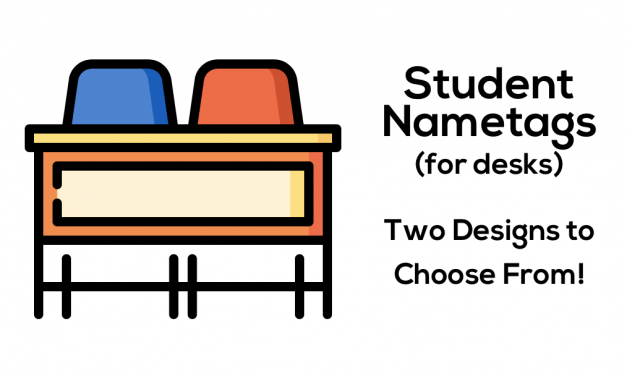
Here is a page for making your own Printable Name Tags. I used these when I was teaching in a summer preschool program. I printed the page off on heavy duty card stock, cut out one strip per student, and then laminated them. I used them as a writing center for little ones to practice writing their names (in this case, I also had to provide many of the kids with a card that already had their name on it). You could also introduce them during the first days of school. For example, before laminating the cards, write each child’s name using a black marker. After lamintaing, place them on the left-hand side of a pocket chart that is visible for the kids when they enter the room in the mornings. As children enter the room to start each day, have them find their name and practice writing it by tracing what you have already done for them. They can then move their cards to the right-hand side of the pocket chart to let you know they are present at school. It’s quick, easy, inexpensive, AND reusable-love it!
Posts Tagged ‘First Grade’
Name Tags
May 23rd, 2009Art Project of the Week-Turtle
May 23rd, 2009We are really going green with this cutie of a turtle. He is made with an apple sauce cup and a plastic spoon. The best thing about this project-no need for glue!
Supplies Needed:
- apple sauce cups (emptied and cleaned), 1 per child
- green paint, brushes and smocks, 1 per child
- plastic spoon, 1 per child
- green construction paper, 1 5X8 piece per child
- pencil, 1 per child
- markers, 1 per child
- tape, 5 small pieces per child
Allow each student to paint the outside of an apple sauce container. While the paint dries, demonstrate how to make the turtle’s body parts. Using a pencil, plastic spoon, and green construction paper, trace the top of the spoon for the turtle’s head one time and the end of the spoon (trace down until you reach the middle of the spoon handle) four times. Once traced, cut out the pieces. Tape the straight end of each piece to the inside of the dry apple sauce cup. Bend the ends of each leg to make the feet. Finally, use a marker to draw a face. Don’t forget to name the little cutie!
Greater Than, Less Than, Equal to
May 13th, 2009Here is a lesson written for first graders that teaches the concept of the greater than, less than, and equal to concepts. The lesson makes use of two Gators and a Clam. It is a fun way to help students grasp the skill of using those tricky symbols!
>, <, = Lesson Plan
Subject: Math Grade: First Grade
Lesson/Topic: >, <, and = Length: 50 minutes
Unit: Greater Than, Less Than, and Equal to
Objectives:
Students will be able to compare two quantities (up to 12) and determine which is greatest and least amounts.
Students will be able to compare two quantities (up to 12) and determine when they are equal.
Students will use the symbols >, <, and = to show a true equation between two quantities.
MA Standards:
2.N.1 Name and write (in numerals) whole numbers to 1000 and order the numbers.
2.N.2 Identify and distinguish among multiple uses of numbers, including cardinal (to tell
how many).
2.N.4 Compare whole numbers using terms and symbols, e.g., less than, equal to, greater than
(<, =, >).
Materials and Resources:
Each of the teacher made items will be used to provide instruction at the beginning of the lesson.
1 Greedy Greater Than Gator (Teacher made)
1 Lester Less Than Gator (Teacher made)
1 Pond Place mat (Teacher made)
Each child made their own Greedy Gator and Lester Gator in the previous lesson. The pond place mats are laminated so the children can write the quantity of food in each pond directly under each island.
1 Greedy Greater Than Gator (1 per child)
1 Lester Less Than Gator (1 per child)
1 Pond Placemat (1 per child)
1 >, <, = Worksheet (1 per child)
1 Dry Erase Marker (1 per child)
1 Bag of Beans or other counting manipulative (1 per child)
1 number line per child (optional)
Introduction:
Students should gather on the “carpet area”. State the objectives by telling them that at the end of today’s math lesson, you want them to be able to say, “I learned how to compare two numbers and use symbols to tell if they were greater than, less than, or equal to one another.”. Ask them to recall the math lesson from the previous day. Review concepts taught: place the “Greedy Greater Than Gator” and the “Lester Less Than Gator” on the whiteboard (they’re magnetic). Ask for a volunteer to briefly recall the story about Greedy and Lester. They should remember which is which-Greedy and Lester have to share the pond, but both agreed that they will ONLY eat from their own island in the pond. And even though Greedy always wants more, he is honest. Review the names of each symbol (gator’s mouths) and how they are read. Also, that the open mouth always points to the larger number. In the case of the “lesser than” symbol, the smaller end of the symbol points to the smaller number. On the place mat, show the students that there are 6 pieces of food on the first island and 4 pieces of food on the second island (draw big round dots to represent food). Have the students tell you how many are on each side as you draw them and then write the number underneath each island. Ask for a show of hands for a volunteer who can show how to make the equation true using one of the gators. Have the students read the equation with you. Next, switch the numbers. Call on a volunteer to demonstrate. Again, have the students read it with you. Review how we know which sign is which. Next, ask the students which sign we should use if 2 pieces of food were added to the first island(add the food). Ask the students how many pieces of food there are and change the number to show 6 on each side. Tell the students that because both sides are equal (write the word on the board) we use a different symbol. Show the kids that neither gator works because not one side is lesser or greater than the other. Tell the kids that our equals sign is the same sign we use when we are answering addition and subtraction facts. The equals sign tells us that the equation is true. Introduce “Eli the Equals Clam”. Tell the students that when two numbers are the same, they are equal. And during our activity, we will use Eli the Equals Clam instead of the gators to show when two numbers are the same. Use Eli to show the following examples on the board:
1. 5=6 Ask the students if the equation is correct. Demonstrate how to make it true and explain why. Call on students for ideas.
Repeat with:
2. 3=4
3. 7>9
Procedure:
Tell the students that they are going to work with their gators as well as the “equals clam” to show true equations. Remind students that the open part of the gator always points to the bigger number and when the numbers are the same that means they are equal. Show students a copy of the practice worksheet. Instruct students on how they will complete the worksheet and show their work using their gators, clam, and a place mat. The first one is done for them. Ask students to recall how they used their gators and mats for the previous lesson. For example #1 reads:
1. 1 > 0
The children should write the 1 under the first island and the 0 under the second. Next, they should show 1 bean on the first island and none on the second. In the space between each island, they should place a gator or a clam to make the equation true. The students should then write the correct symbol on their worksheet for that same equation. Encourage students to refer to the number lines on their desks if they are unsure of the value of each number.
As students work, ask them questions to encourage their thinking. Some questions are:
1. What happens if one island has none?
2. How do we read the equation when both sides are the same?
3. If this group has the least amount, how much does the other have?
4. Why are you placing your gator in that direction?
5. What are the gator mouths used for?
Allow students approximately 30 minutes to complete the independent activity.
Conclusion:
Direct students to join on the carpet area. Ask the students to share some of the things they learned in this activity. Ask the students: When did you use the equals clam? When did you use the greater than gator? the lesser than gator? Did you think this was hard or did you feel comfortable using each animal/symbol? Do you think you could use the gator mouths/symbols without the gator bodies? Tell the students that will be the focus of our next lesson! Have the students recall what the objective is by repeating it. Ask them if they feel that is what they learned today. Hopefully all of them say yes! Have the children turn to the person next to them and tell what they learned in math today.
Assessments:
Students will be informally assessed throughout the lesson. They will be assessed on their participation in the group discussion and individual activity as well as on their completion of the in-class worksheet. Observations of how students show each equation on their work mats and questioning (see above) of how they obtained their answers will also be used to determine their level of understanding.
The following rubric will be used to assess the completed worksheet: (Total number of questions=15)
4=All correct 3=10-15 correct 2=5-10 correct 1=5 or less correct
Extensions:
Have students compare numbers greater than 12.
Have students write two numbers and compare without using manipulatives.
Have students compare two numbers and then tell them to add or subtract from one side to demonstrate an inequality (example: “Show me 5<8. Now add 4 to the first island. How is the equation read?”).
Modifications:
To challenge-for students who can easily identify which groups of numbers are more and less, the student(s) should be given gators that have been cut to expose only the mouths (the symbols). Students should then compare the quantities using just the symbols.
To simplify-for students who are having difficulty identifying which groups are more and less, the student(s) should be told to count each “piece of food” aloud and to place a picture of the matching number with the manipulatives for each island. The student(s) should then do the same for the other island. Using a number line, have the student(s) determine which number is more than the other. Demonstrate how “Greedy Greater Than Gator” will eat the number that is on his island-this number comes first and it is more so we read the symbol as greater than. Repeat the process to develop understanding and independence.
You can also have struggling students who may need help work with a buddy. That way you can monitor them more closely and provide help.
Another strategy would be to fold the worksheet in half and have a student complete only part of it if it is too difficult or overwhelming.
What is Symmetry?
April 7th, 2009The lesson will begin with the students seated at their desks. The students will be shown a picture of a butterfly. The students will be asked what it means to say that the butterfly is symmetrical. Students may recognize that one side of the butterfly is the same as the other. Students will be told what symmetry means and told that many things in nature often have symmetry/are symmetrical. They will then be shown several examples (a leaf, a rainbow, a daisy,etc. They will then be asked if they can name anything in the classroom that has symmetry. Examples will be given. The students will then be introduced to the activity. Each student will receive a copy of dot paper. Once distributed, the class will be shown how to fold the paper in half lengthwise along the center line. With the paper folded in half, I will use an overhead projector to demonstrate how to cut out a triangle, leaving the uncut fold as one side. Students will be asked to do the same. Before children unfold their papers, the students will be asked if someone can draw a picture on the chalkboard of how he or she thinks the figure will look once the paper is unfolded. The children will then be asked to unfold their papers to see what figure was created. Students will be asked to tell how the halves on both sides of the fold are alike. Some students may recognize that both halves show triangles that have exactly the same shape and the same size. The students will then be told that when the halves on both sides of a line match in shape and size, we can say that figure is symmetrical and we can call that line a line of symmetry. The students will then be given a picture of a heart cutout. Students will be asked to draw a line of symmetry on the heart. Students should recognize where the line of symmetry is. Students will then be given construction paper in order to make other shapes-a square, a circle, or an invented one. How to fold and cut the paper will be demonstrated. For each shape, students will be asked to draw the line of symmetry on it.
What’s Alive?
March 15th, 2009Abstract:
This lesson starts out with a great book that introduces students to living and nonliving things. Students are then given the opportunity to work collaboratively to complete a picture sort of living and non-living things.
To find the book for this lesson, follow our link to Amazon.com.
| Subject(s): |
Science
|
||||||||||||||||||||||||||||||||||||||||||||||||||||||||||||||||||||||||||||||||||||||||||||||
| Topic or Unit of Study: |
This lesson is an introductory lesson within a unit on animals.
|
||||||||||||||||||||||||||||||||||||||||||||||||||||||||||||||||||||||||||||||||||||||||||||||
| Grade/Level: |
Kindergarten
|
||||||||||||||||||||||||||||||||||||||||||||||||||||||||||||||||||||||||||||||||||||||||||||||
| Objective: |
Students will be able to distinguish between living and non-living things.
|
||||||||||||||||||||||||||||||||||||||||||||||||||||||||||||||||||||||||||||||||||||||||||||||
| Summary: |
The teacher will read a book that introduces differences between living and non-living things. The students will complete an activity to apply their knowledge of living and non-living things.
|
||||||||||||||||||||||||||||||||||||||||||||||||||||||||||||||||||||||||||||||||||||||||||||||
| IMPLEMENTATION | |||||||||||||||||||||||||||||||||||||||||||||||||||||||||||||||||||||||||||||||||||||||||||||||
| Learning Context: |
A unit on animals will be introduced. This lesson will be an introductory science lesson so students will learn to distinguish between living and non-living things.
|
||||||||||||||||||||||||||||||||||||||||||||||||||||||||||||||||||||||||||||||||||||||||||||||
| Procedure: |
The students will be asked to sit as a group on the carpet. They will be introduced to the science lesson by being shown an actual potted houseplant and a pot with non-living flowers in it. The students will be asked to give a “thumb up” if they think the houseplant is a living thing. The students will then be asked to give a “thumb up” if they think the non-living flowers are a living thing. The teacher will then read the book, What’s Alive? by Kathleen Weidner Zoehfeld. The students will then be asked again to give a “thumb up” if they think the houseplant or the flowers are a living thing. Most students should agree that the house plant is a living thing. The students will then be asked to recall what they heard in the book. The students will be asked why the houseplant is a living thing and why the flowers are a non-living thing. As a group, the students will discuss the differences between the living and the non-living things. The students will then be asked to return to their desks and be introduced to the activity. The students will be directed to pair-up with their science buddy (pre-selected by the teacher) and sort pictures according to whether they are of living or non-living things. Once sorted, the teacher will verify that each pair has been sorted correctly and then supply glue for the students to complete the activity by gluing the pictures under the correct category on their papers. Students, because of their limited reading abilities will be directed to sound out the words on the worksheet (living and non-living) and to look for the first letter in each word to identify each category (living and non-living).
|
||||||||||||||||||||||||||||||||||||||||||||||||||||||||||||||||||||||||||||||||||||||||||||||
| Collaboration: |
Students will work collaboratively. Students will work in groups of 2.
|
||||||||||||||||||||||||||||||||||||||||||||||||||||||||||||||||||||||||||||||||||||||||||||||
| Time Allotment: |
1 class period. 1 Hr per class.
|
||||||||||||||||||||||||||||||||||||||||||||||||||||||||||||||||||||||||||||||||||||||||||||||
| MATERIALS AND RESOURCES | |||||||||||||||||||||||||||||||||||||||||||||||||||||||||||||||||||||||||||||||||||||||||||||||
| Resources: |
|
||||||||||||||||||||||||||||||||||||||||||||||||||||||||||||||||||||||||||||||||||||||||||||||
| STANDARDS & ASSESSMENT | |||||||||||||||||||||||||||||||||||||||||||||||||||||||||||||||||||||||||||||||||||||||||||||||
| Standards: |
|
||||||||||||||||||||||||||||||||||||||||||||||||||||||||||||||||||||||||||||||||||||||||||||||
| Assessment/Rubrics: |
Students will be assessed based on their participation throughout the topic discussion and their completion of the living/nonliving activtiy.
|
||||||||||||||||||||||||||||||||||||||||||||||||||||||||||||||||||||||||||||||||||||||||||||||
Biweekly Reading Log 2
March 15th, 2009This is another biweekly reading log for mature readers (no space for parent verification). It includes date, book title, author, and an area for parent or student comments.
Student Reading
March 15th, 2009The following is a list of books that I recommend for independent student reading. Through my experience, these books have proven to be appropriate for fluent readers and enjoyable reads.
Chapter Books:
Recommended Grade Level (1-2)
~The Horrible Harry Series by Suzy Kline
~The Magic Tree House Series by Mary Pope Osborne
~Big Apple Barn Series by Kristen Earnhart
~Nate the Great by Marjorie Sharmat
~Frog and Toad by Arnold Lobel
~Amelia Bedelia by Peggy Perish